unknown non ASCII characters

Hi everyone, we've come across a very peculiar issue with the C1 12 (and 20&21) filename output when it comes to batch renaming. We are three photographers using different hardware, all iMac's, and all using our own profiles and workspaces to work with. However on two different machines with each it's own different user we noticed C1 added a special non-ascii marker for unknown reason.
Y54231210_ASSORTED_001_.tif
this is what you'd normally see in a finder window, you don't see any extra characters in the filename but when you copy and paste this filename in ms excel you will find a very strange non ascii marker that will prevent other software to function properly.

We've ran into issues with an ftp upload program declining an entire batch of files because one of the files had this marker in it's filename. A similar problem occured with our DAM system when trying to upload multiple files.
We've all checked and emptied our batch rename fields but the problem seems to re-occur on it's own from time to time.
Is there anyone who knows how to fix or prevent this from occuring?
I've added a screenshot of our batch rename window and is pretty basic, you can see there are no extra spaces or anything...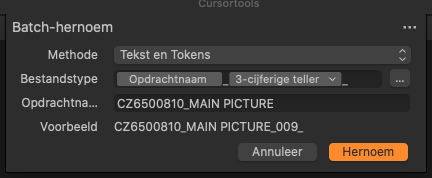
Best regards.
-

> Jan van der Meulen: but when you copy and paste this filename in ms excel you will find a very strange non ascii marker that will prevent other software to function properly
Likely a character set mismatch or a missing font. The question mark framed in a box may be Mac's replacement character when character code is represented in your font.
Any chance that you can post the sequence of byte (octet) values that make up the character string containing the offending character?
0 -
> OddS.
From https://www.rapidtables.com/convert/number/ascii-to-binary.html :::
00010010
reverse is possible met UTF-16::
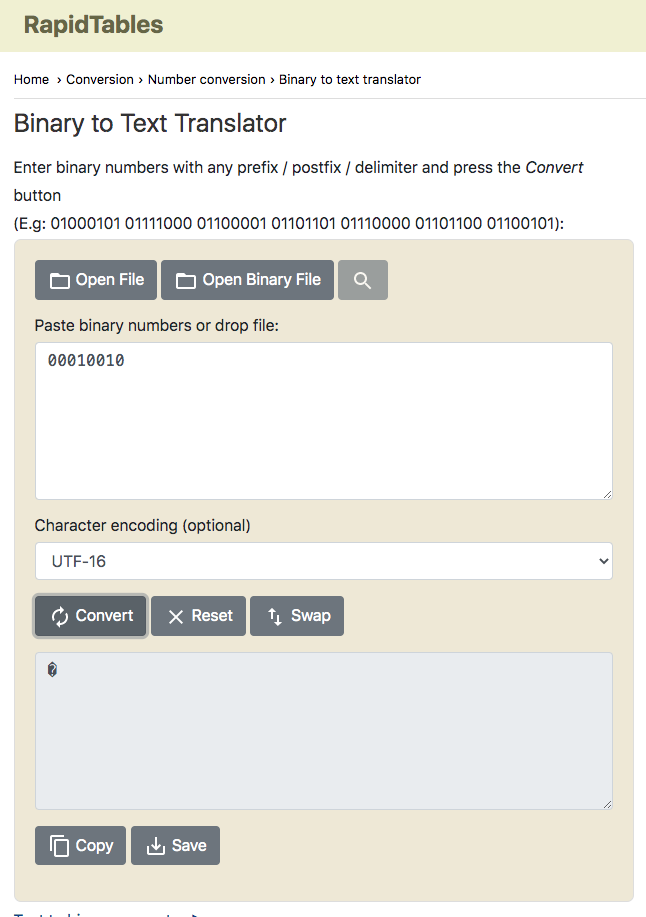
Regards Jan
0 -
> Jan van der Meulen: 00010010
That is an ASCII control char (hex 12, decimal 18) called "Device Control 2" in the docs. I have possibly used it to control some of my own serial port/modem devices back in the day, but I have no idea why it appears in your character string. But that is irrelevant. More to the point: you did not post what I requested, it is too little information for me to work on. May be some other forum member will chime in to assist you.
0 -
>OddS
could you maybe be a bit more specific about the byte designation you have for your research.
Possibly an example screenshot of what you mean.
We only use standard fonts.
0 -
> Jan van der Meulen: We only use standard fonts
Don't we all, but fonts may not have a glyph for every single code point which make it unprintable. It is quite common for applications to display/print a replacement character. Anything that stands out, a question mark, a period and what not, but a question mark enclosed in a diamond symbol is popular, some use it reversed, black diamnond white question mark. You see a question mark in a rectangle (or square).
I wrote: "Any chance that you can post the sequence of byte (octet) values that make up the character string containing the offending character?"
Here is the sequence of byte (octet) values that make up the character string that you posted:
 Y  5  4  2  3  1  2  1  0  _  A  S  S  O  R  T  E  D  _  0  0  1  _  .  t  i  f
59 35 34 32 33 31 32 31 30 5F 41 53 53 4F 52 54 45 44 5F 30 30 31 5F 2E 74 69 66
I spaced out the string Y54231210_ASSORTED_001_.tif to make the character sequence match the hexadecimal sequence below it, but it may not survive on the web. It does not contain the offending character. I have no idea if the sequence matches what you had in your computer or not. That is what I hoped to see.
Your 8 bit (ASCII) hex 12 in a UTF-16 setting made no sense to me.
0 -

Running a git status shows a series of files as being modified, even though I've just cloned the repo. All of the files include non-ASCII ...Non-ASCII space bar clicker characters are those that are not encoded in ASCII, such as Unicode, EBCDIC, etc. ASCII is limited to 128 characters and was initially developed for the English language.
0
Post ist für Kommentare geschlossen.
Kommentare
6 Kommentare